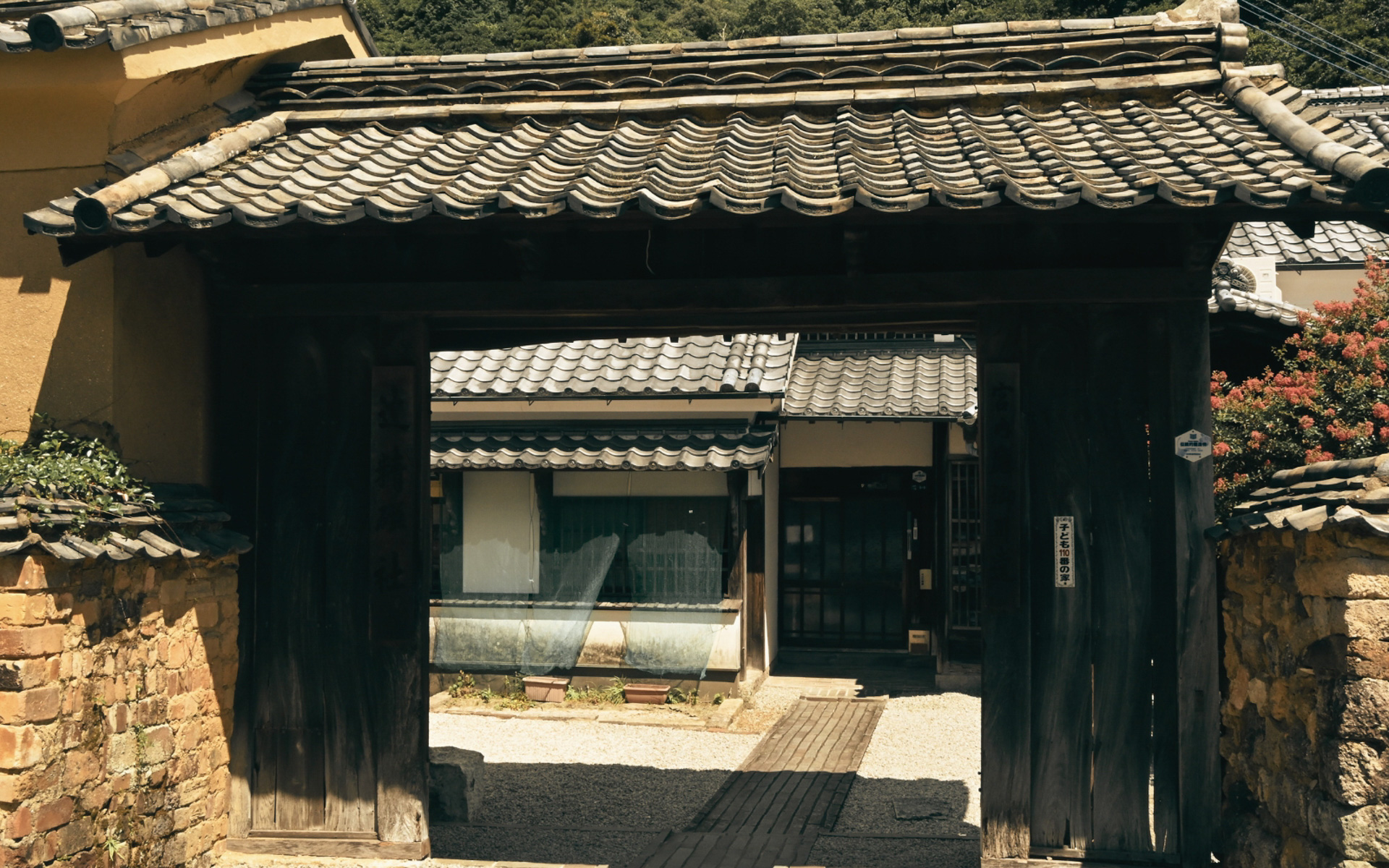
Tucked among Arita’s famous Tombai wall alleys, the historic estate of Tsuji Seijisha is steeped in 350 years of porcelain-making heritage and lives within the town’s Important Preservation District. As I sit in the zashiki (formal tatami room) of 16th-generation kiln master Hiroki Tsuji, the late July heat begins to rise from the narrow streets outside.
Arita-yaki (有田焼) is porcelain traditionally produced in and around Arita, Saga Prefecture, one of Japan’s most historic porcelain-making regions. Production began in the early 17th century, and Arita became especially known for finely crafted white porcelain decorated with cobalt blue, coloured enamels, and intricate designs.
Tsuji-sensei sits across from me, his manner quiet and unassuming, despite the extraordinary legacy he carries. His wife, an accomplished artisan in her own right, greets us with local Ureshino green tea. She places featherlight, exceptionally smooth porcelain cups in our hands, the same pieces used by Japan’s Imperial Household.
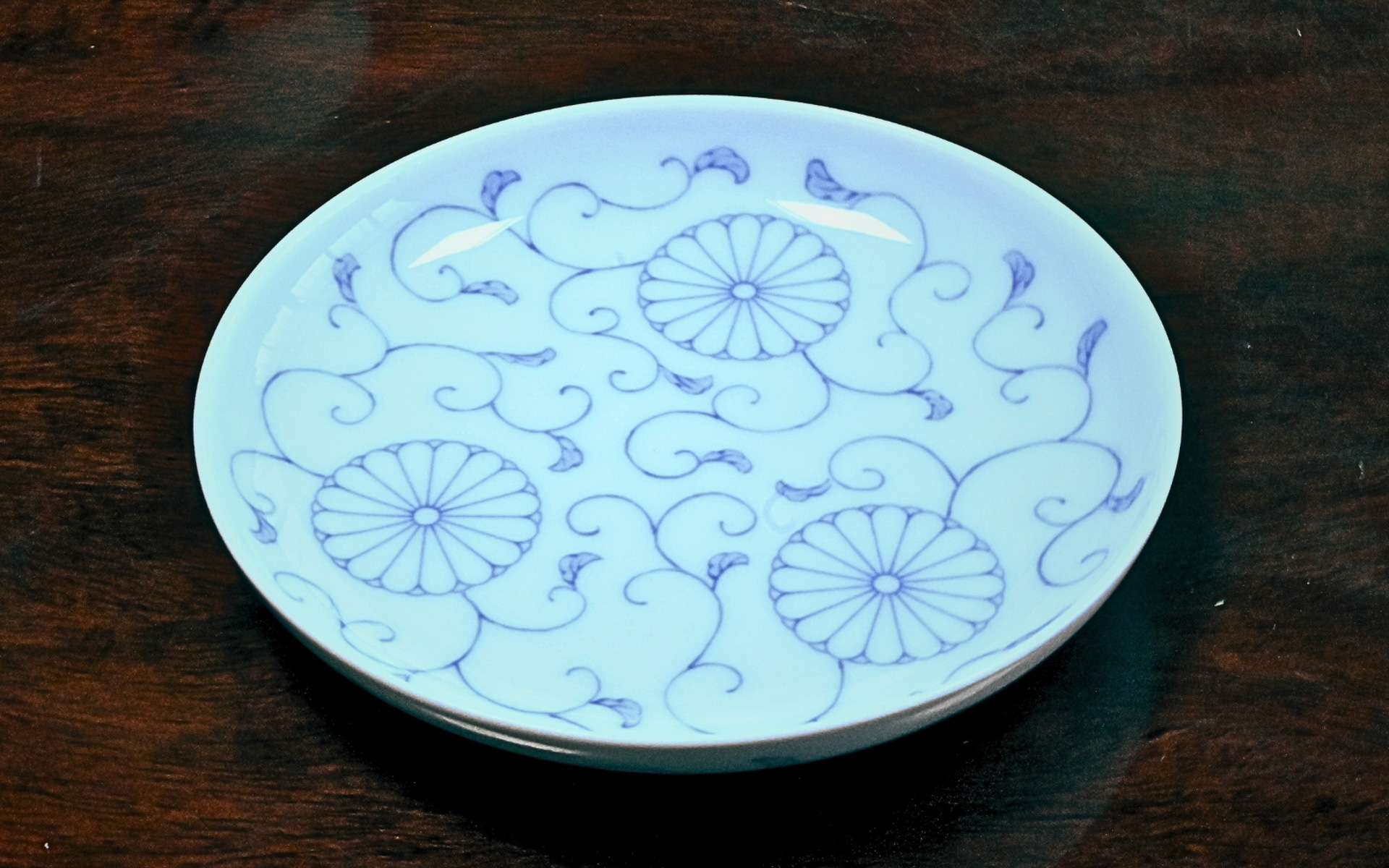
Around us, intricate blue-and-white porcelain horse and elephant figurines sit beside a wooden cabinet filled with exquisite gold-and-white Western-style dining plates, a colour combination strictly reserved for the Imperial family.
A 350-Year Relationship with Japan’s Imperial Household
Each piece reflects a relationship with Japan’s Imperial Household that began in 1668, when Kiuemon Tsuji, the family’s third-generation master, presented their exceptional white porcelain to Emperor Reigen through Mitsushige Nabeshima, lord of the Saga Domain.
Impressed by its quality, the Emperor granted the family an official rinji (imperial decree), elevating Tsuji Seijisha above commercial makers and naming the kiln an official purveyor to the Imperial Court. For the next two centuries, Tsuji Seijisha remained the Court’s sole official porcelain producer.
In 1811, eighth-generation master Kiheiji Tsuji developed Gokushin-yaki, a technique designed to protect royal commissions from the soot and ash produced by traditional climbing kilns. Each vessel was enclosed in a sealed outer shell, or saggar, made from the same clay. Fired together, the two protected the piece inside while producing an unusually deep cobalt blue and glass-like lustre. Once firing was complete, the outer shell was broken away with an iron hammer, revealing the pristine porcelain within.
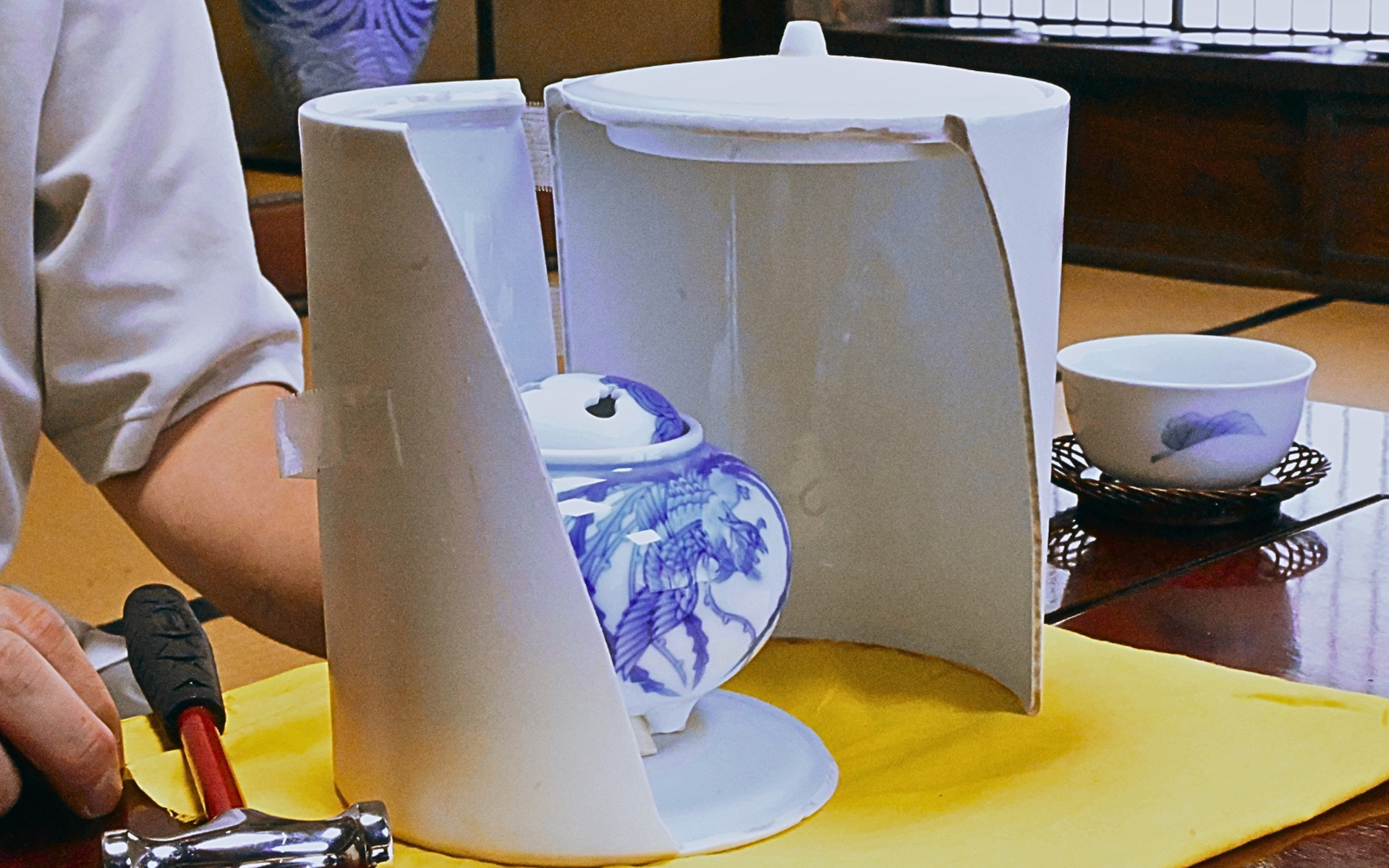
Although the technique is no longer used in regular production today, it was revived and passed down by the 14th-generation master. More than two centuries after it was developed, Tsuji-sensei demonstrates the process for me, breaking away the protective shell with an iron hammer to reveal the porcelain inside.
After the Meiji Restoration in 1868, demand from the Imperial Court grew beyond what Tsuji Seijisha could produce alone, Tsuji-sensei tells me. Other kilns began supplying the Court, but the Tsuji name remained the most trusted. In 1874, the Imperial Household Ministry commissioned 11th-generation master Katsuzo Tsuji to create Japan’s first Western-style white porcelain dining sets for the Court.
Now, those gold-and-white plates rest on the table in front of me, their delicate surfaces bearing the Imperial chrysanthemum crest.
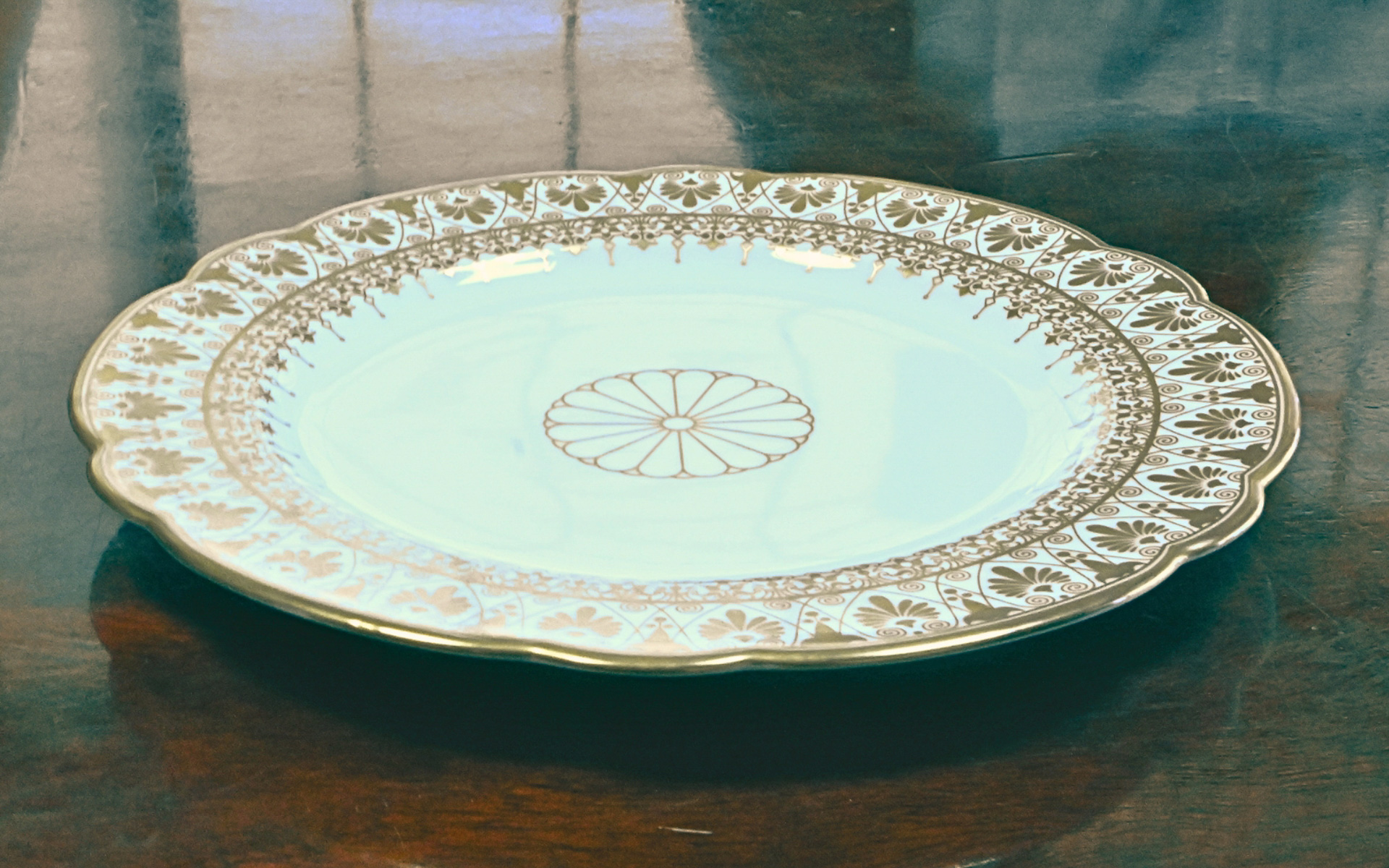
“If a piece like this breaks, we are called upon to recreate it exactly the same as before,” Tsuji-sensei tells me. “There is high pressure, of course. They deserve only the absolute best, but we are proud to be the ones entrusted with this task.”
The commissions have continued across the generations, with special pieces created for significant royal occasions, including the ceremonial sake cups for Princess Nori’s coming-of-age ceremony in 1990.
Curious how it feels to shape and fire your own piece? Find tableware workshops across Japan
Inside Tsuji Seijisha's Workshop: Where the Porcelain Takes Shape
Moving into the dimly lit workshop, I am initially confused by how quiet it is. Rather than the metallic clatter of heavy machinery, there is only the gentle hum of fans keeping the summer air moving. Above my head, long wooden planks suspended from the ceiling hold rows of raw, unglazed porcelain, left to dry.
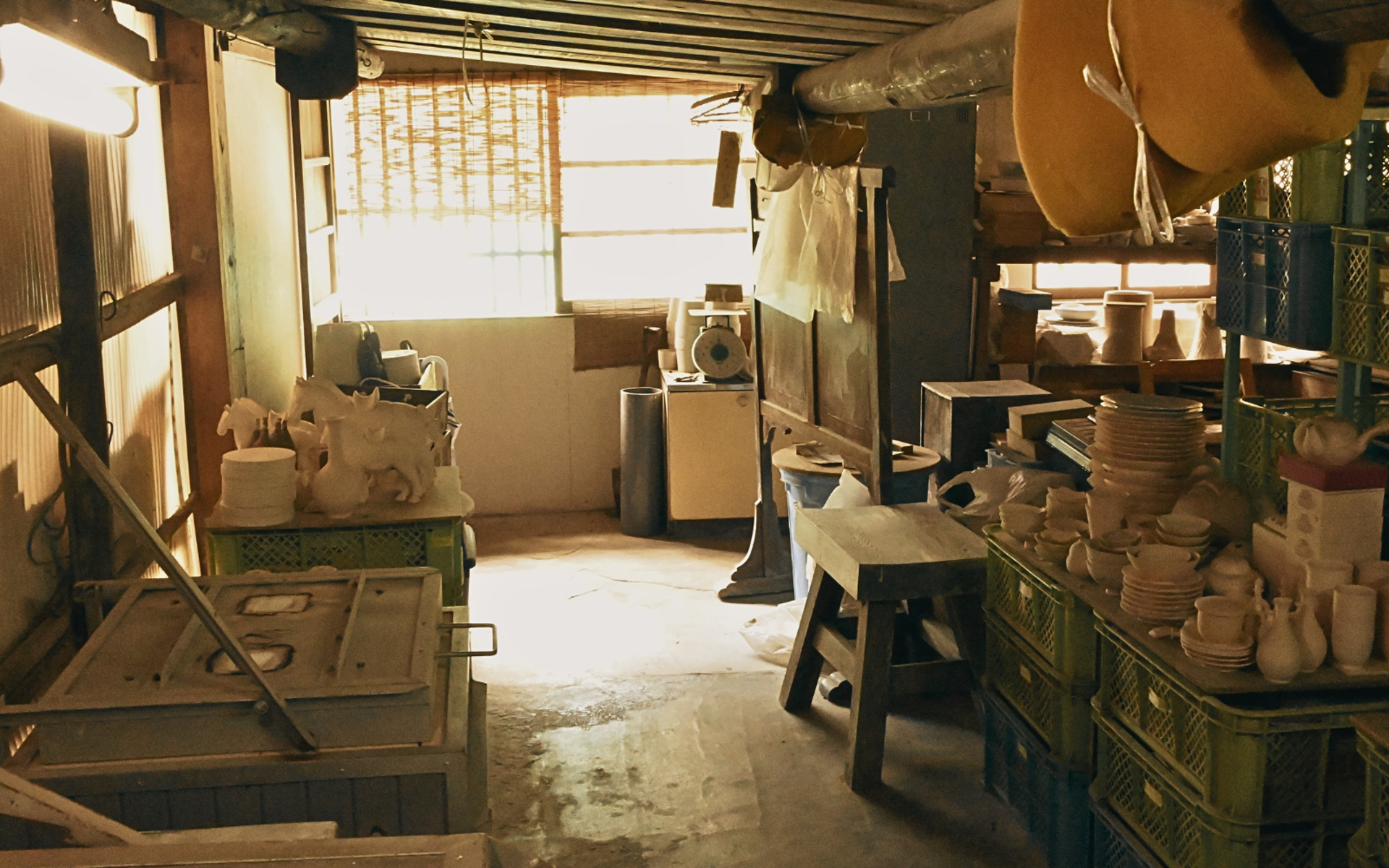
After feeling a strong earthquake the night before, I glance up nervously and ask Tsuji-sensei if they lost any pieces. “None,” he smiles calmly. “The ground in Arita is strong. We hardly feel the shaking here.”
He hands me two test pieces of pottery, one air-dried and the other bisque-fired at 950°C, and invites me to snap them. I had hoped to avoid breaking porcelain in this historic workshop, but as the unfired piece gives way like an eggshell between my fingers, I begin to understand why each stage matters.
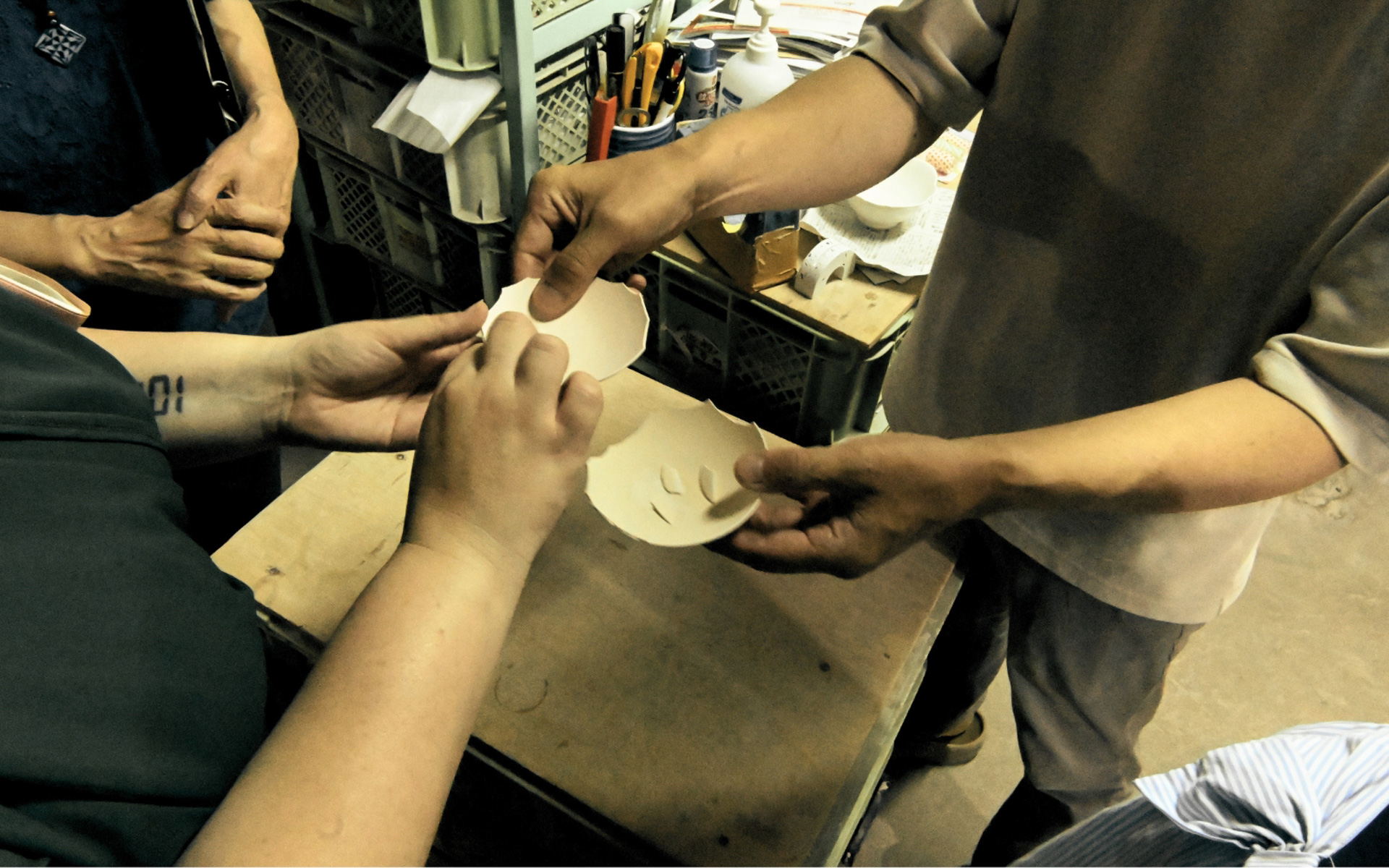
Tsuji-sensei explains that the preliminary su-yaki (bisque firing) removes moisture, strengthening the piece while leaving it porous enough to absorb pigment.
Nearby, three artisans work almost silently, each focused on a different stage of the process.
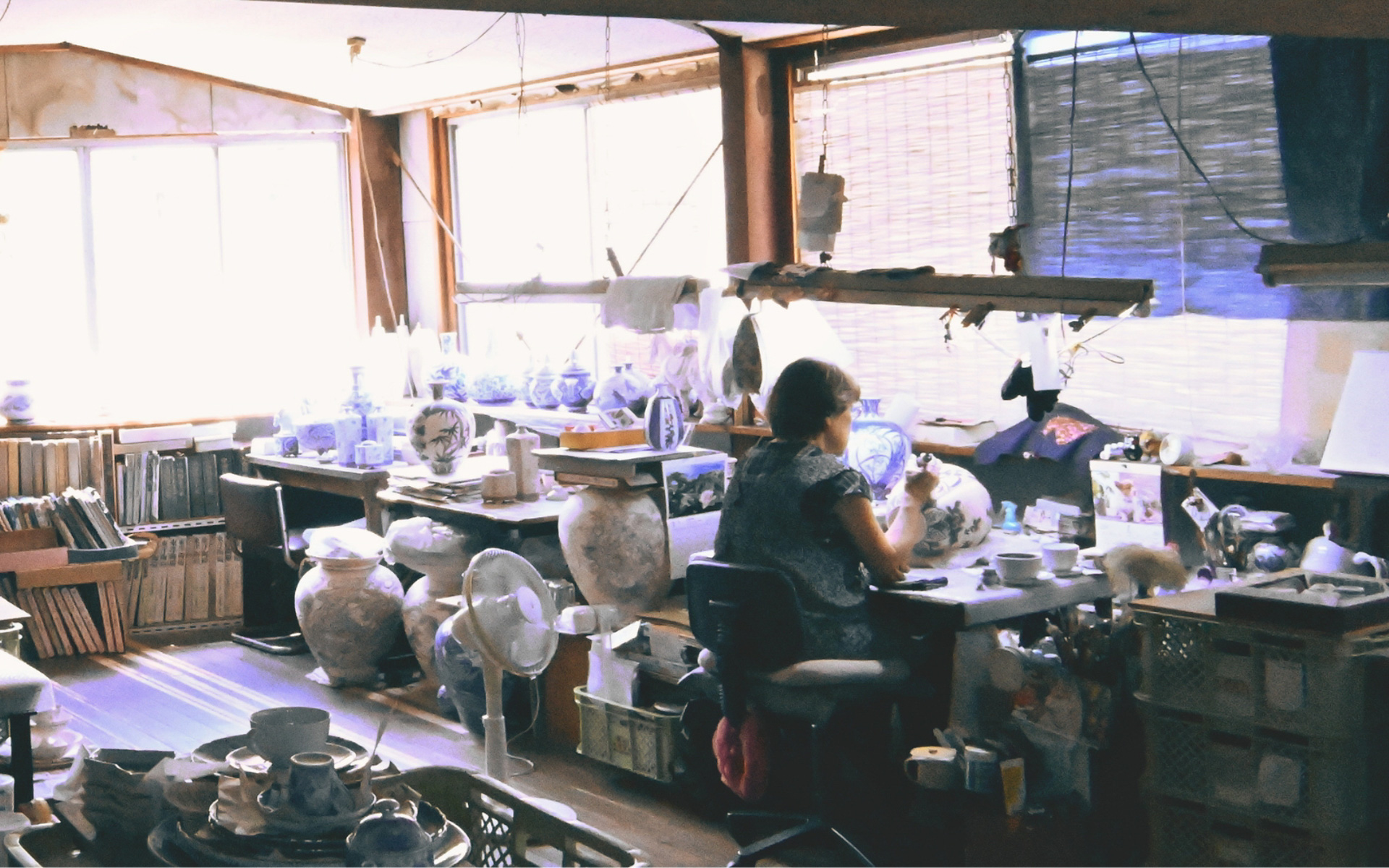
Charcoal Transfer (Zugan):
At one desk, an artist sketches designs onto special paper with charcoal. Above him, shelves hold pieces bearing transferred designs, while charcoal smudges cover his desk and the wall behind him. Rubbing the paper with a smooth stone transfers the design onto the porous porcelain, where it will burn away during firing.
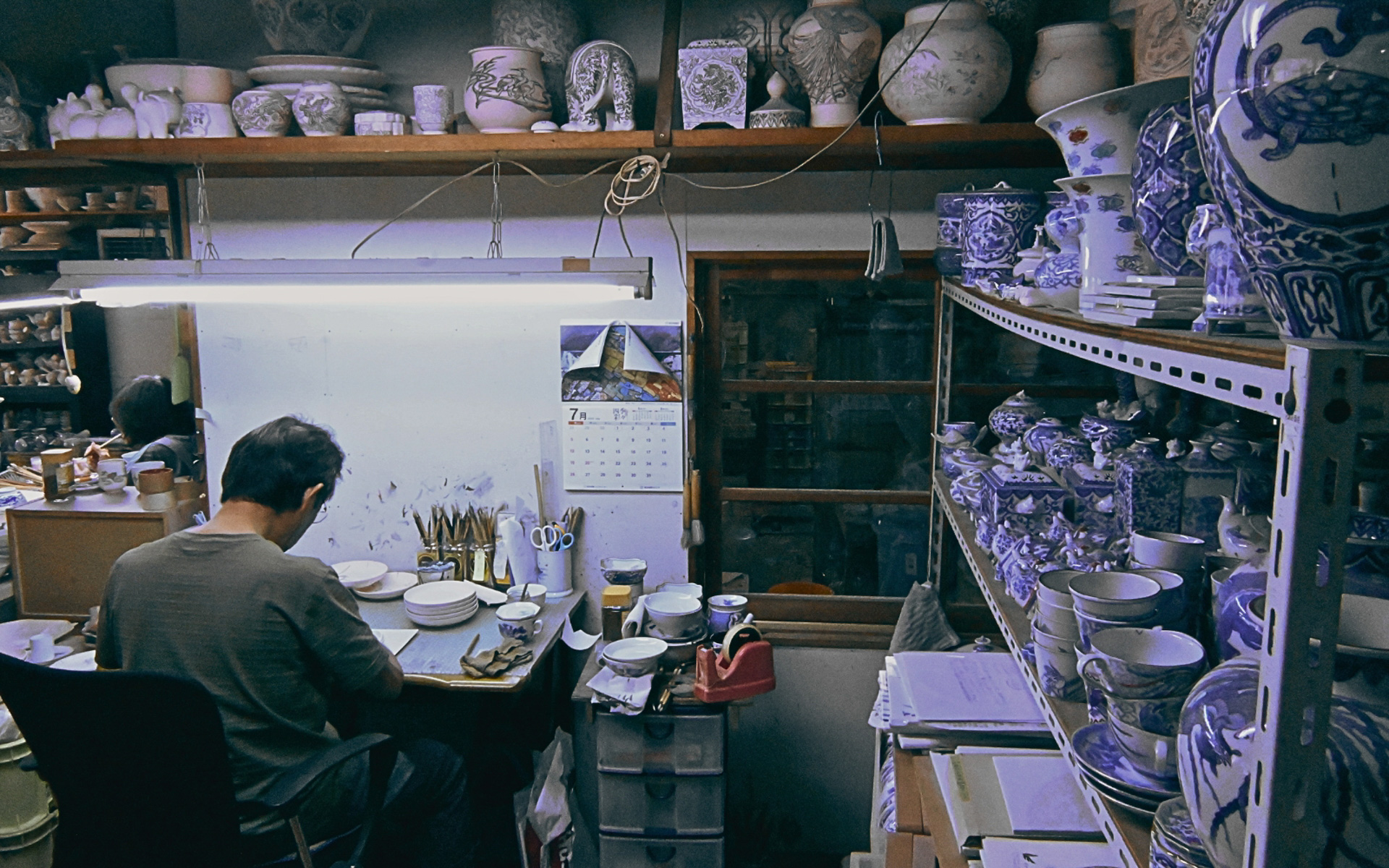
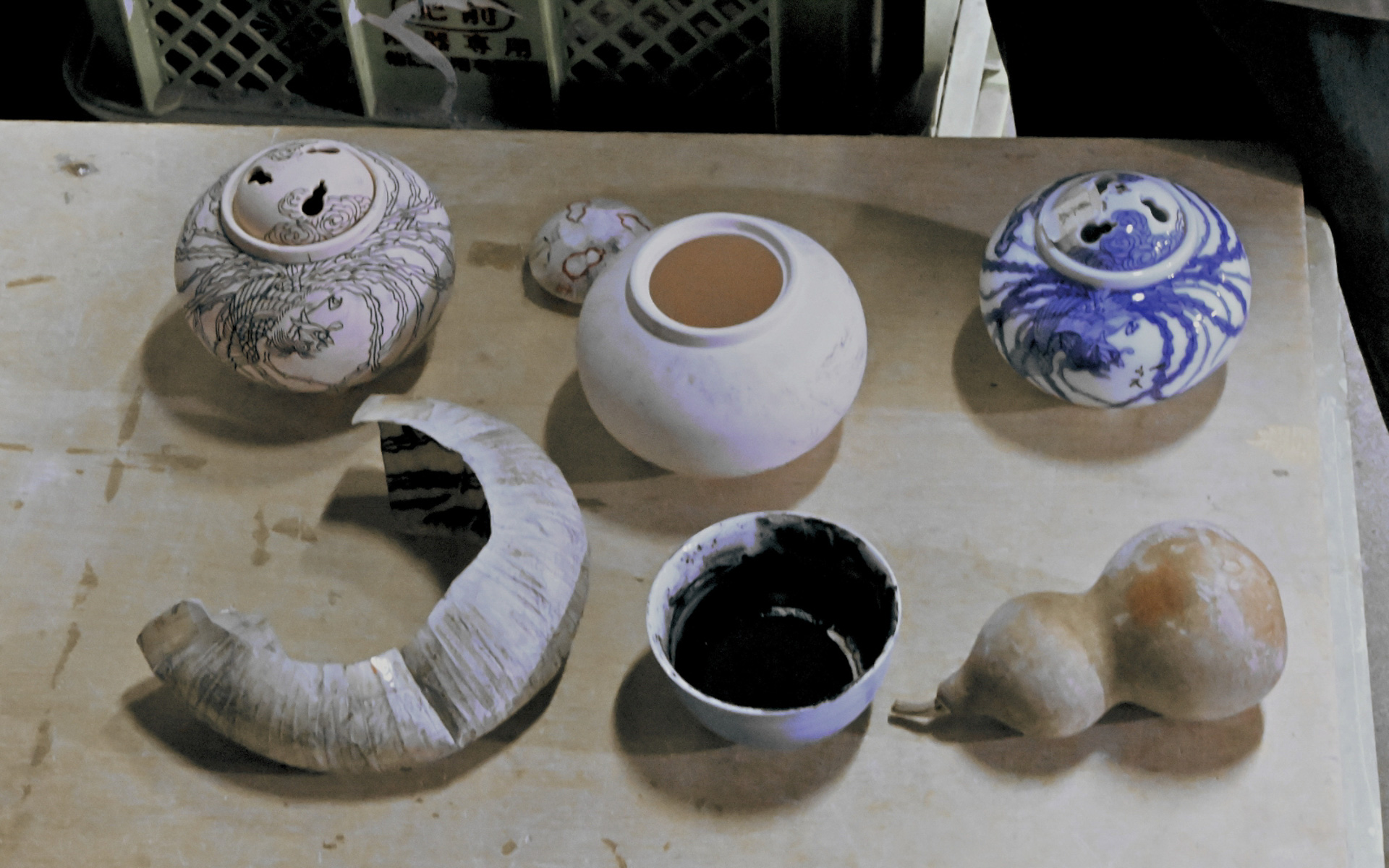
Underglaze Cobalt (Sometsuke):
At the next desk, a woman paints over the charcoal lines with gosu, a cobalt pigment. Her desk is crowded with brushes, while an identical finished piece shows what the porcelain will become.

Glost Firing (Honyaki):
Outside the painting room, a bowl of glaze waits to be used. Its thick, pale mixture reminds me of pancake batter waiting to be cooked.
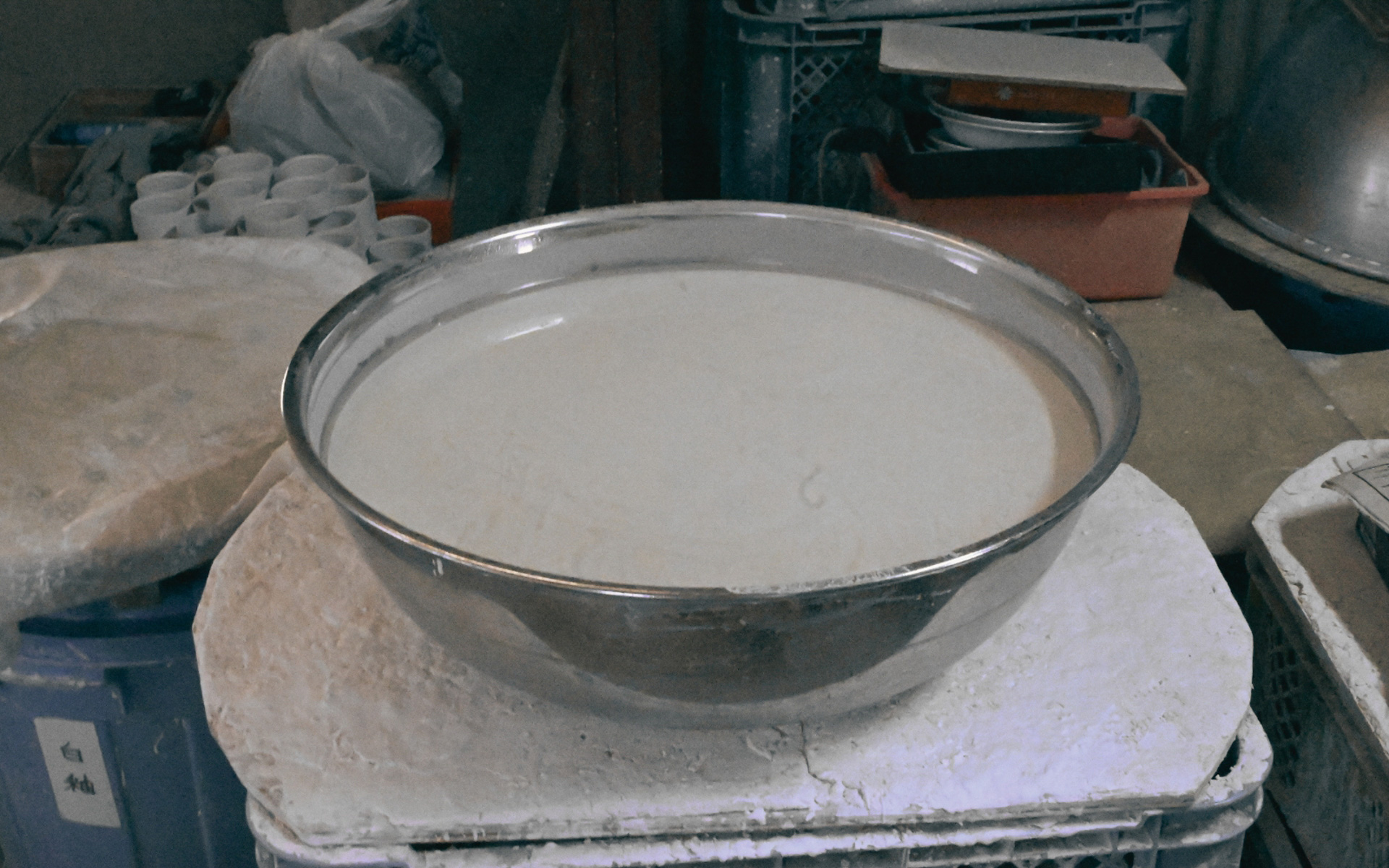
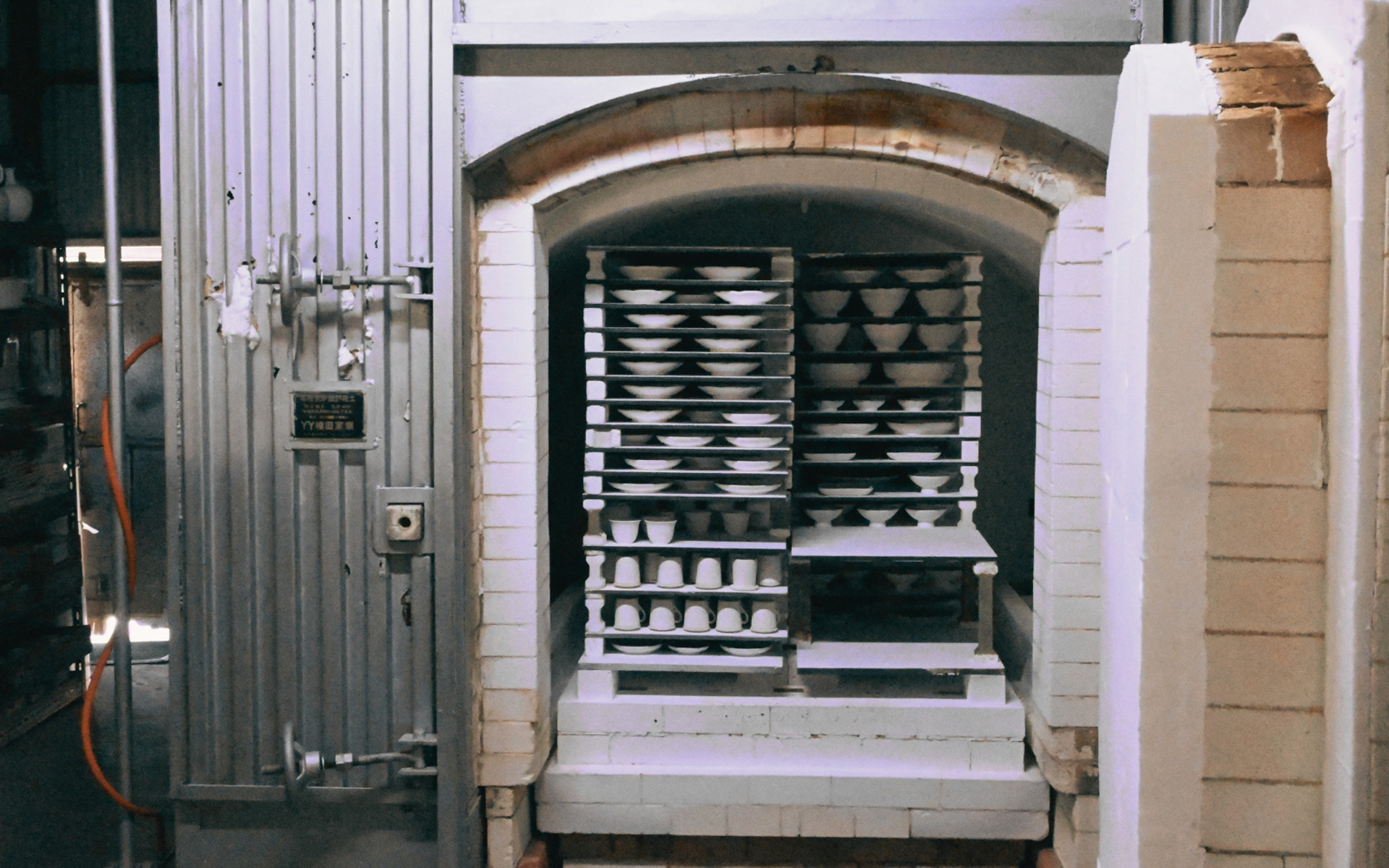
Once glazed, pieces are fired in a gas kiln at 1,300°C for nearly 19 hours, transforming the muted pigment into vivid cobalt blue.
Overglaze Enamels and Gold (Akae):
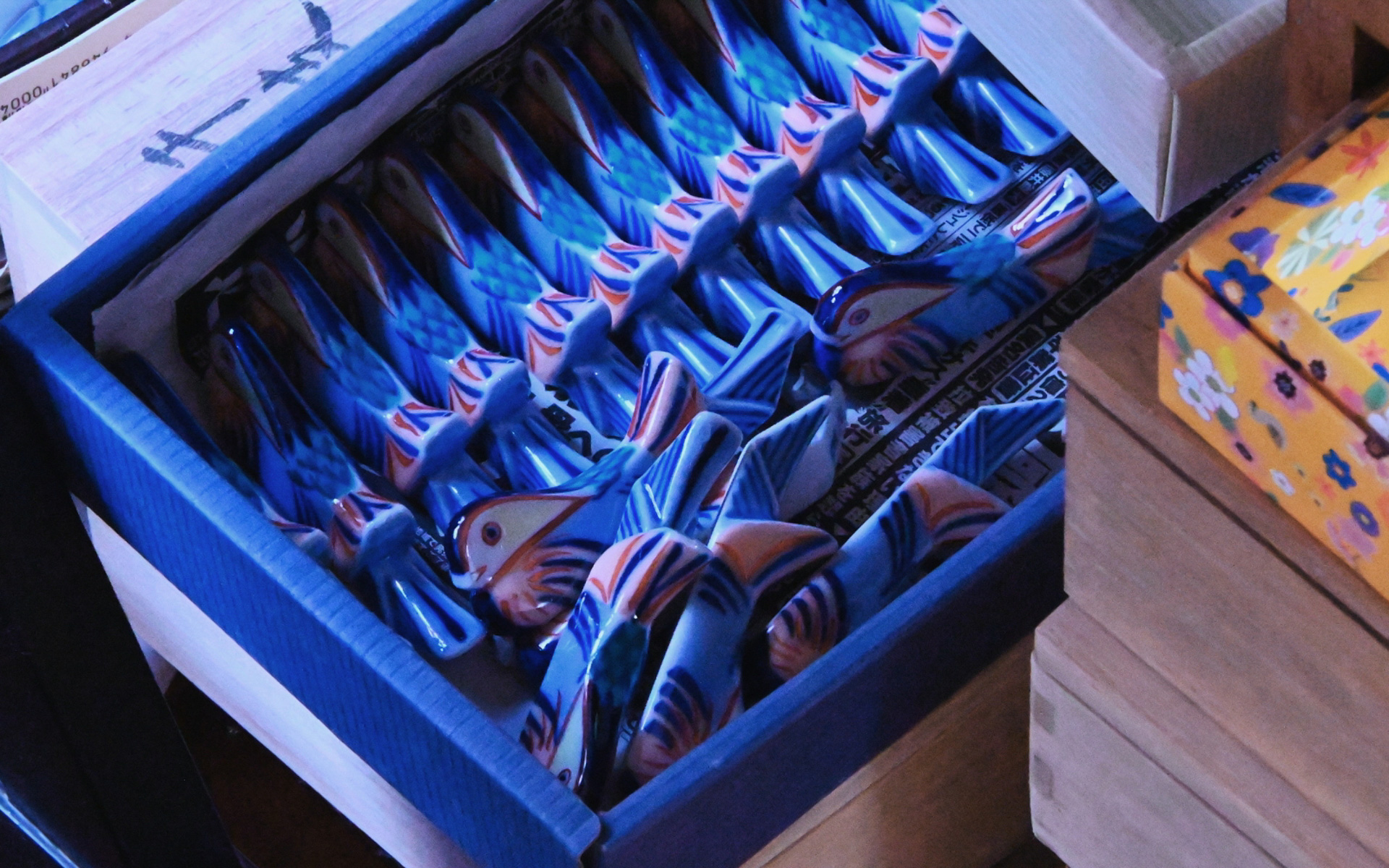
In another corner, Tsuji-sensei's wife is engrossed in painting reds, greens, and gold onto the fired porcelain. A final firing at 780°C fuses these delicate details without burning away the gold.
Keeping the Tradition Alive: The Future of Tsuji Seijisha
Sitting back down with Master Tsuji after our tour, he shares a reality common to many traditional Japanese master craftspeople today: modern resource scarcity.
Natural porcelain stone quarried in neighbouring regions is becoming harder to source, costs are climbing, and raw-material quality is fluctuating. Even the specialised tools essential to their delicate work, such as the brushes needed for fine line work, are increasingly difficult to acquire as fewer artisans remain to make them.
Yet when I ask Tsuji-sensei about the future of Tsuji Seijisha, his outlook remains positive. Though only 20 to 30 groups visit the workshop each year, he sees every visit as an opportunity to preserve their history.
“We want to keep Arita’s traditions and culture alive by sharing our craft,” he says. “We simply want to continue making excellent blue-and-white porcelain, pieces that resonate with the heart.”
That continuity ultimately rests on the next generation. Much as his own father gave him the freedom to choose his path without pressure, Tsuji-sensei has offered that same independence to his own children.
“Neither my son nor my daughter is forced into the family business. It is their choice,” he explains. Both, however, have already declared their intention to join the workshop once they complete their schooling.
In an era when many traditional arts struggle to find successors, the 350-year-old lineage of Tsuji Seijisha stands secure, passed down not out of duty, but out of a shared, enduring pride.
To dive deeper, visit the Tsuji Seijisha website, shop at their online store, or follow them on Instagram.
Planning a visit to Arita? Start at the Arita Ceramic Museum for an overview of the town's 400-year porcelain story.
Want to try making your own tableware in Japan? Browse workshop experiences on Bottlecap.jp's directory.
About the article author:
Kerri King is a travel writer and media creator from Aotearoa, New Zealand, currently based in Japan. Specialising in regional Japan, they cover traditional crafts, regional and family travel, alongside their favourite topic: travelling by train.
Photography by Dylan King
Want to discuss this article? Check out the "Japan Handmade Forum" on Discord to join the conversation!
Know someone we should interview next? Send us a recommendation at hello@bottlecap.jp
This page may contain affiliate links, and Bottlecap may earn a commission at no extra cost to you.